







200 years of history for this historic chalet
A living mountain home
No standardization here: an old farmhouse, a family history.
This is what unites the different addresses in our collection. Every room, every wall, every detail tells a story: the story of a chalet in Les Contamines-Montjoie. handed down, renovated and lovingly lived in for over 200 years.

From family farm to chalet hotel: origins since 1823
1823 Construction of the family farm by Pierre-Joseph Mermoud
1920: Renovation of 2 rooms in the farmhouse for summer rental. His daughter Anne-Marie Mermoud cooks there.
1930 : Anne-Marie and her husband Fernand move into the “Gai Soleil” farmhouse. Farming and hospitality continue to coexist.
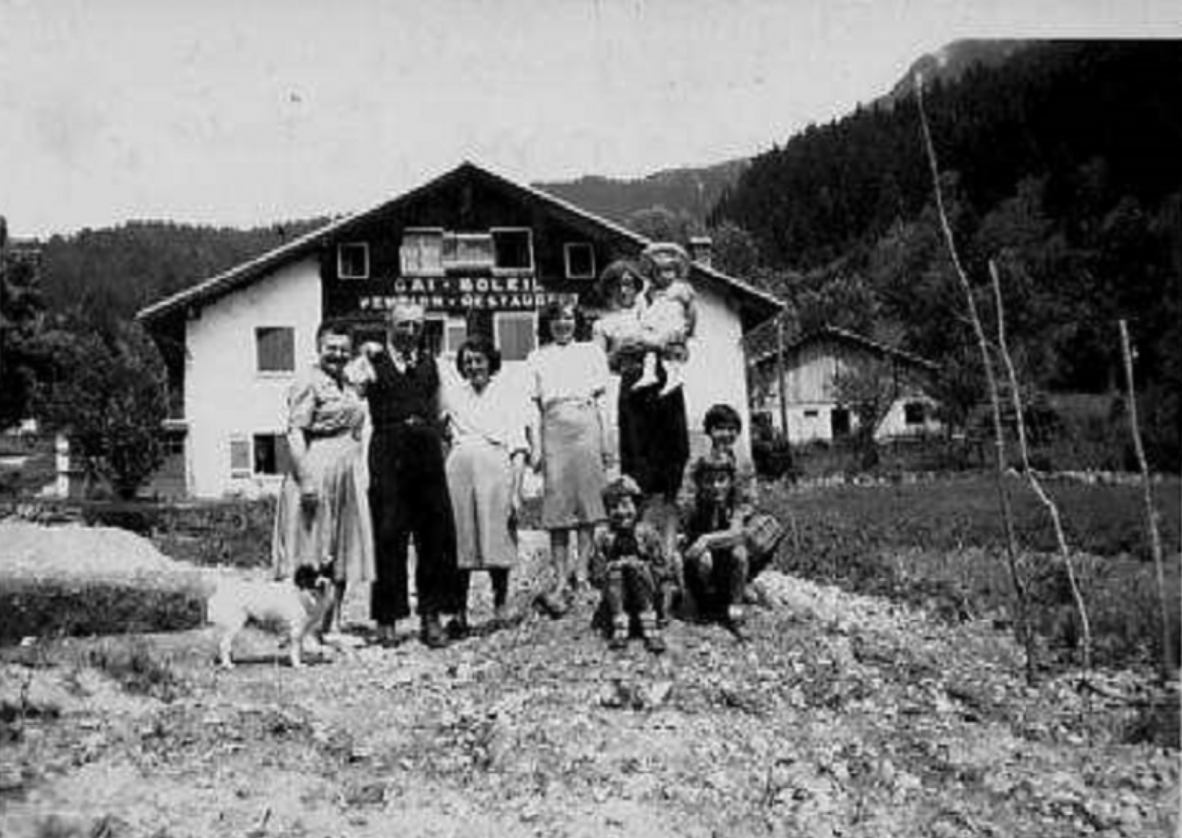
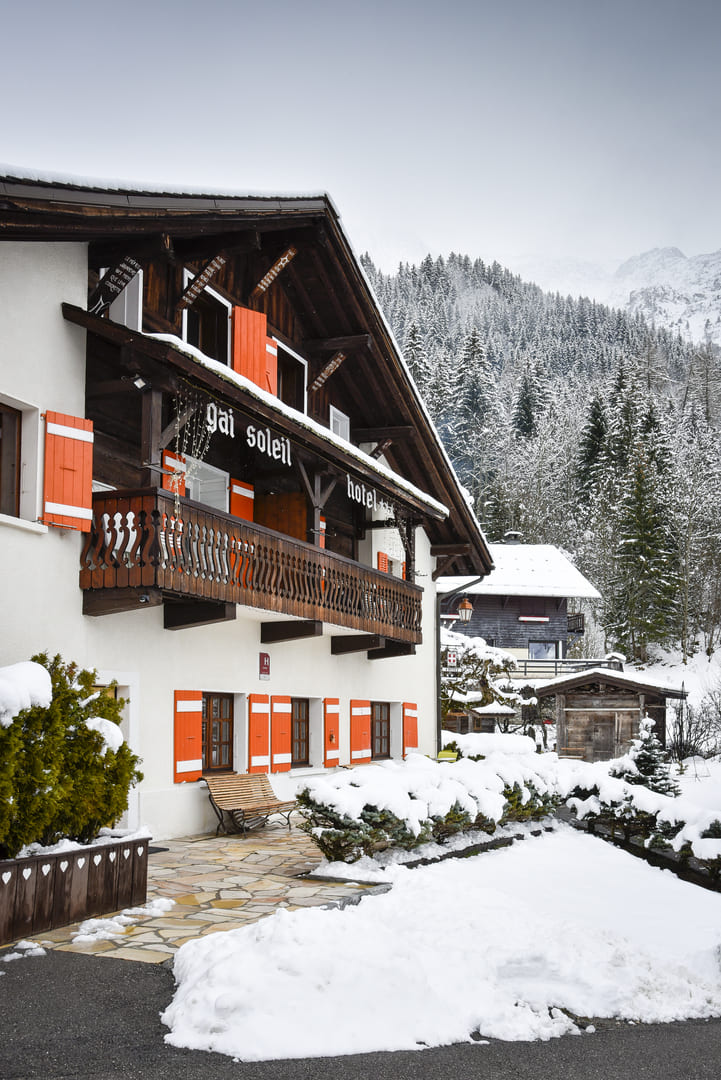
1947: Renovation work and opening of Le Gai Soleil as a hotel-boarding house (10 rooms) in Les Contamines Montjoie. It is run by Anne-Marie, Fernand and their children.
1962: end of farming operations.
1968: Renée Mermoud, their daughter, takes over the management of this hotel in Haute Savoie.
1976: Total renovation
2016: Acquisition of the hotel by Valérie, David and Lucas Krommenacker (after 193 years with the Mermoud family), who continue the family hotel tradition.
2026: Acquisition of the hotel in Contamines Montjoie by Loïc Renart – Collection Les Aubergistes Lyonnais.
The story told, without pretense
Written by Albert Mermoud in June 1997
In the early summer of 1947, the Hôtel Gai Soleil welcomed its first guests. But it wasn’t the Gai Soleil we know today.
Pierre-Joseph Mermoud built the farmhouse in 1823 to accommodate his large family. Born in 1796, he married twice, had four children from the first marriage and ten from the second. This may explain his bulimia for houses, as he built four of them!
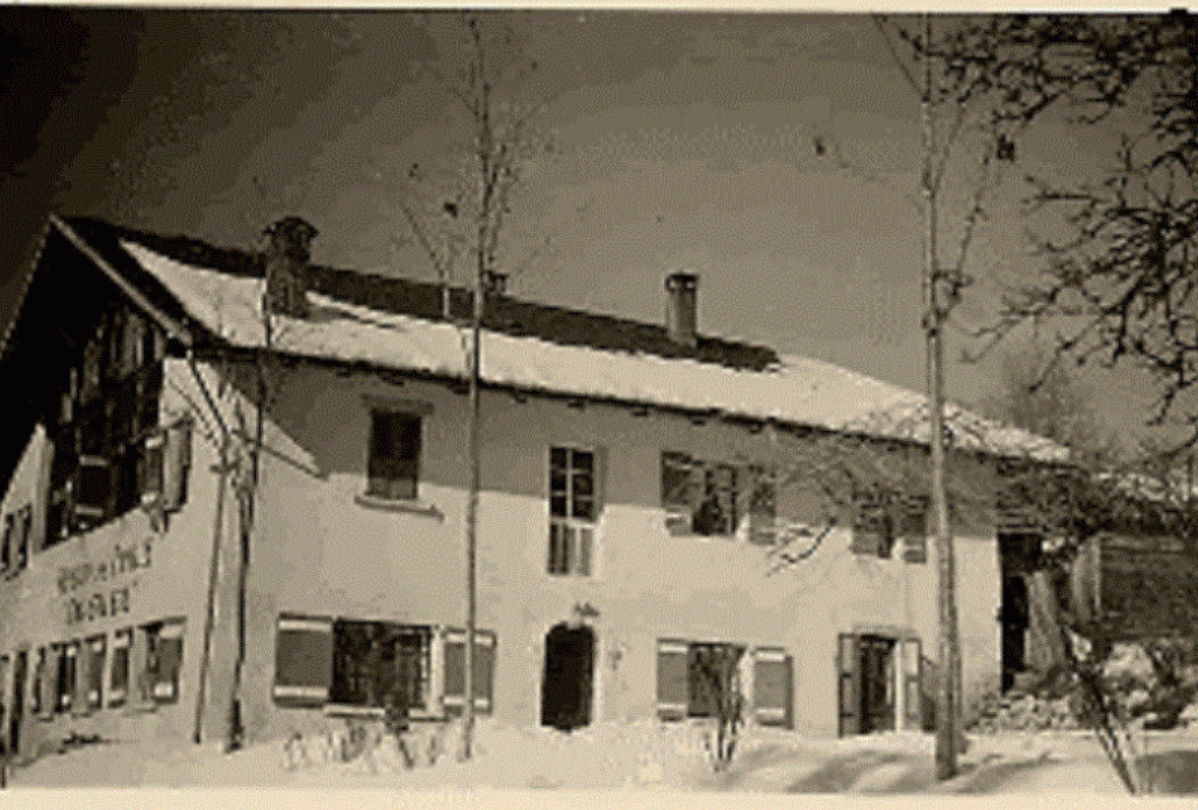
Old photos give us a precise idea of what the farmhouse that was to become Gai Soleil looked like: a solidly built structure with 80-90 cm thick walls, the top of the east and west facades made of wood, on two levels, a “lodge” on the west facade and a roof made of “ancelles” (slabs of spruce wood cut into the grain).
The story of Gai Soleil begins around 1920… with our grandfather Albert, grandson of Pierre-Joseph, born in 1871. He was a farmer-breeder; in summer, he owned the Bûche-Croisée and Roselette mountain pastures, and also traded in livestock. He was open to the modern world, to the point of being one of the first people in Les Contamines to own an automobile… Seeing that the upper part of the valley was attracting more and more tourists, he had two rooms fitted out in the farmhouse for summer rental. But there was no question of abandoning farming and pastoral activities.
It was also in the early 1920s that Anne-Marie Espritoz, our mother, was introduced to cooking and welcoming tourists at the age of 12. Her aunt and uncle ran the Tré-la-Tête refuge in the summer. Its cuisine is so renowned that tourists, it is said, climb up there for the pleasure of eating! The cooking was all butter and cream. Poultry, rabbits, sheep and cows were bred for milk and its by-products. Although the setting and furnishings were rustic, the cutlery was silver, much to the chagrin of Anne-Marie and her sisters, who were responsible for maintaining it at Le Blanc d’Espagne. They had to watch out for guests arriving at the bend in the forest, about 30 minutes from the hotel, help kill and skin the animals, and sometimes go down to the village if something was missing… Then it was our mother’s turn, working alongside her aunt, to really learn the hotel business, as well as cooking, pastry-making and hospitality. Without realizing it, she would find herself preparing for a new profession twenty years later.
Anne-Marie married our father, Fernand, in 1930… and came to live on the farm – now the Gai Soleil – after our grandfather’s death that same year. The thirties were difficult. The division of the grandparents’ inheritance, the hardships of death and illness, the sale of assets to replace a still non-existent social security system, little land in the valley to feed a large family – all these factors led our parents to look for another way of subsisting. After the war, tourism was to offer them this opportunity.
Our mother had retained a taste for contact with tourists, and had little trouble convincing her husband to go into the hotel business, starting at the bottom of the ladder in the family guesthouse, while Fernand continued to farm the land: cows and guests coexisted in the same building!
Everything that couldn’t be used was broken, and windows were opened with difficulty in walls that looked as if they’d been built the day before, to create the dining room and 10 bedrooms. A bar was set up, the kitchen equipped and, by early summer 1947, the Hôtel-pension Gai-Soleil was welcoming its first guests. Of course, the children were put to work: I was sent on cooking courses, and Renée, Ginette and Jeanne-Élise were also introduced to the trade during the school vacations, as was Gilberte later on.
The beginnings were not easy, especially financially. The very modest prices, and the constant concern to serve customers well, often beyond what would have been necessary to ensure an honest profitability, nevertheless had the happy consequence of quickly giving the establishment a solid reputation and building customer loyalty. However, it was necessary to do whatever it took to develop the business and cover the heavy financial costs of the loan taken out for the refurbishment. The bar remained open all year round for locals, and was also used as a restaurant for workers. We also catered for communions, weddings, class parties and veterans’ banquets… But the most popular activity was the balls that our father enjoyed organizing once or twice a year. He did it as much to increase revenue as for his love of the accordion and dancing! He didn’t hesitate to bring in accordionists whose reputation extended far beyond Savoy’s borders, bringing in people from all over the valley.
The idea, very fashionable today, of combining a farm and a hotel, wasn’t really fashionable at the time, but it didn’t go too badly, with customers appreciating the products directly from the farm. However, the situation was not to last. Ten rooms, or around twenty guests, were not enough to make ends meet. More rooms had to be built, using another part of the barn’s volume, and the cattle had to be moved out of the house. In the early ’50s, a separate barn was built. This freed up the volume of the barn, allowing three new bedrooms to be built on the second floor.
The cohabitation was over, but not the dual activity, which was becoming too much to bear. But it lasted for another ten years, until 1961/62. No more farm produce, no more pâtés and smoked sausages prepared by our mother from the pig she raised for this purpose with the kitchen leftovers, no more milk and cream of the day, no more chickens, ducks, goats and sheep from the farm! Customers must have grumbled a little, and understandably so. But for the family it was undoubtedly worse: for the first time in centuries, a generation was abandoning what had always sustained their ancestors in this valley. A nostalgic, if not painful, page was turned. And in 1963 the cowshed was replaced by a chalet for our parents.
In 1968, our parents entrusted the running of the hotel to Renée, who had always worked there. From then on, she never stopped renovating, building, decorating and embellishing. She has inherited our mother’s passion for building, and will give it free rein, to her great delight and that of our guests, who discover new improvements every year.
In 1973/74, she enlarged the dining room, added a large living room and created five new bedrooms in the barn’s remaining space. But what had gone before was no longer to her taste, nor, she felt, to that of her customers. So, in 1976, she went back to the drawing board, adding two more bedrooms. A new kitchen, up to standard, was rebuilt. Naturally, the exterior walls and roof were preserved to preserve the house’s character.
The most recent major renovation: in 1993, the roof was redone to give more space and light to three bedrooms on the second floor, by creating large balconies, much appreciated, as you can imagine. But Renée’s concern for respecting the old farmhouse’s shape and style went so far as to have the entire roof covered with “tavaillons”, as in the old days, but this time with a wood unknown to our ancestors: Canadian red cedar or giant tuya.
What’s next for Gai-Soleil Farm? Let’s hope she continues to give pleasure to her guests during their vacations, just as she gives pleasure to her hosts, in a shared pleasure.